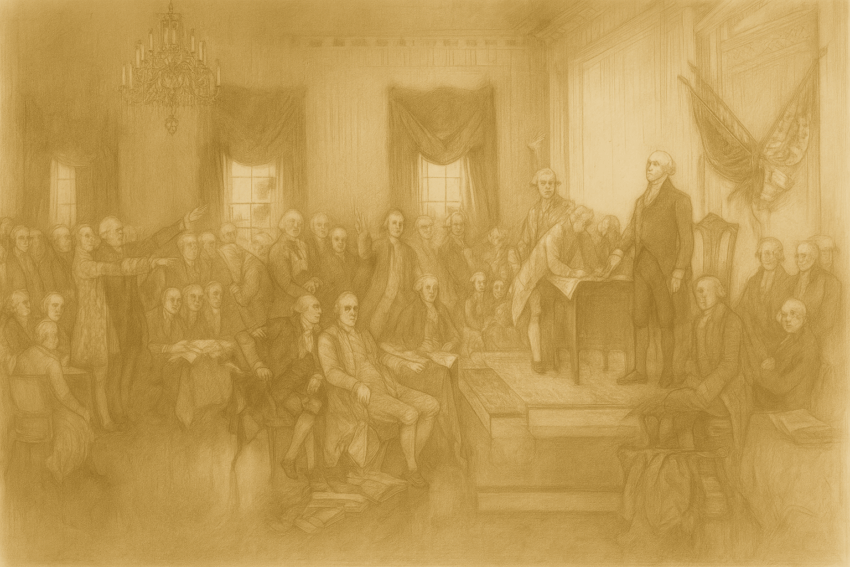
They were imperfect men in an imperfect age. But in their best moments, the Founding Fathers spoke with a clarity that still cuts through the noise of our own time: that the worth of a citizen should be judged not by race, religion, or creed—but by merit, virtue, and contribution to the common good.
This principle wasn’t just a philosophical nicety. It was the scaffolding of a republic.
Thomas Jefferson, in the Declaration of Independence, declared that “all men are created equal,” endowed not by government but by their Creator with unalienable rights. That phrase has been quoted, challenged, and reinterpreted for centuries -but its intent was radical. It rejected aristocracy, caste, and inherited privilege. It laid the groundwork for a society where merit could rise and tyranny could fall.
Alexander Hamilton, writing in Federalist No. 36, emphasized the importance of competence and public trust in republican government. He observed that “the confidence of the people will easily be gained by a man of known integrity and ability.” For Hamilton, the legitimacy of leadership rested not on birthright, but on merit—on energy, intellect, and civic virtue. He acknowledged the imperfections of popular judgment, noting that “their errors, though often profound, are commonly of the head rather than of the heart.” In Hamilton’s view, a republic must elevate those best equipped to serve—not those merely born to status.
Benjamin Franklin, Benjamin Franklin, ever the pragmatist, saw merit as the true currency of public life. Though he never said it in so many words, his life embodied the principle: in a republic, rank is earned—not inherited.
John Adams believed that virtue was the bedrock of republican government. In Thoughts on Government (1776), he wrote plainly: “The only foundation of a free Constitution is pure virtue.” Adams feared that without moral character, liberty would erode under the weight of faction and ambition. In a letter to his son John Quincy Adams dated June 2, 1777, he advised: “You will never be alone with a good conscience and good company.” For Adams, the measure of a citizen was not race, creed, or wealth—but the strength of their principles and their service to the republic.
Adams saw identity politics—though not by that name—as a threat to civic unity. He believed that the republic must elevate character over category, and that virtue must guide both law and leadership.
George Washington made his position on religious liberty unmistakably clear in his 1790 letter to the Hebrew Congregation of Newport, Rhode Island. He wrote: “It is now no more that toleration is spoken of, as if it was by the indulgence of one class of people that another enjoyed the exercise of their inherent natural rights.”
Washington’s words rejected the notion that religious minorities were merely tolerated. Instead, he affirmed that all citizens possess equal rights by virtue of their humanity—not by the favor of the majority. He continued: “The Government of the United States… gives to bigotry no sanction, to persecution no assistance.”
Washington envisioned a republic where religious identity would never be a barrier to civic belonging. His letter stands as one of the earliest and clearest endorsements of pluralism in American political thought.
Mercy Otis Warren, one of the most articulate voices of the American Revolution, believed that the legitimacy of government flowed from the people—not from privilege or power. In her History of the Rise, Progress, and Termination of the American Revolution (1805), she wrote: “The origin of all civil government is in the will of the people.”
Warren’s words reflect a foundational republican belief: that authority must be earned through consent and service, not inherited or imposed. She warned against the dangers of centralized control and unchecked ambition, writing: “The principles of a free government are to be drawn from a people who have a just sense of their own rights.”
Mercy Otis Warren saw civic virtue – not identity – as the true measure of a citizen. Her vision of liberty demanded active participation, moral clarity, and a rejection of rank-based entitlement. In her view, the republic must be built on reasoned conviction, not social category.
These were not perfect men. Many were slaveholders. Some held views we rightly reject today. But they built a framework that could outgrow their flaws—a republic where merit, not identity, would be the measure of a citizen’s worth.
That framework is under strain.
In recent years, the rise of identity-based policy—whether in hiring, education, or public discourse—has challenged the Founders’ vision. The push for equity, while often well-intentioned, risks replacing one form of discrimination with another. It asks us to see people first by their category, not their character.
The Founders warned against this. James Madison, in Federalist No. 10, cautioned that “the latent causes of faction are thus sown in the nature of man.” He feared that identity-based divisions—whether religious, ethnic, or economic—would fracture the republic. His solution? A large, pluralistic republic where no single faction could dominate, and where individual merit would be the basis of public trust.
Today, we must ask: are we honoring that vision, or abandoning it?
To judge a person by their race, religion, or creed—whether to elevate or exclude—is to betray the very principles that built this nation. It is to forget that liberty is not a gift from government, but a birthright of all. It is to ignore the Founders’ insistence that virtue, not identity, must guide the republic.
This is not a call to erase difference. The Founders themselves were diverse in thought, region, and temperament. But they shared a conviction: that the republic must be built on merit, not favoritism. That equality before the law must be matched by equality of opportunity—not equality of outcome.
In the words of Mercy Otis Warren, one of the most eloquent voices of the Revolution: “The origin of all civil government is in the will of the people.” And that will, she insisted, must be guided by reason, virtue, and merit—not by tribalism or grievance.
We are stewards of that legacy. And stewardship requires clarity.
It requires us to say, without apology, that a republic built on merit is not exclusionary—it is liberating. That to judge a person by their deeds, not their demographics, is not oppression—it is justice. That the Founders, for all their flaws, gave us a framework that can still elevate the best among us—if we have the courage to use it.
So let us remember what they taught. Let us teach it to our children. Let us write it into our laws, our schools, and our civic discourse.
Because in the end, a republic is only as strong as its commitment to judge each soul by its substance—not its surface.
— Mark

Mark Stevens is a veteran IT Systems Architect with over two decades of hands-on experience in both legacy and modern tech environments. From mainframes and Novell networks to cloud migrations and cybersecurity, Mark has seen it all. When he’s not solving complex IT puzzles, he’s sharing insights on how old-school tech foundations still shape today’s digital world.