Mercer Substation: Eagle Mountain’s Power Hub
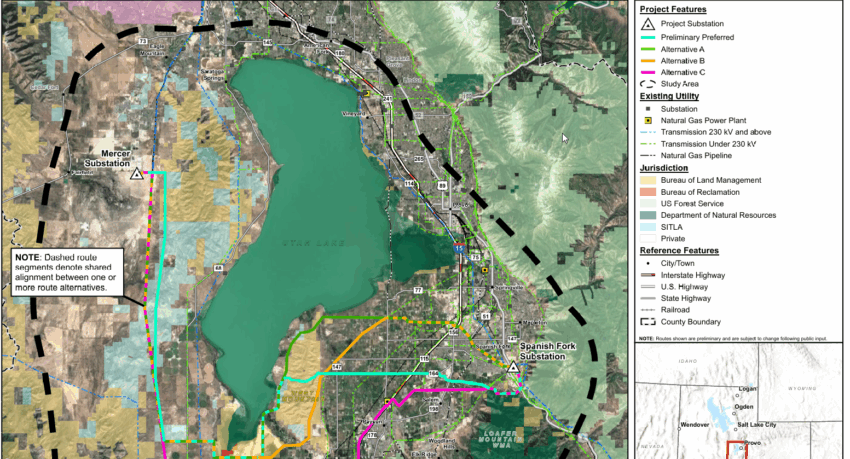
At the heart of the proposed Spanish Fork–Mercer project is the Mercer Substation, located in southern Eagle Mountain near Lake Mountain Road. Built in 2019 to serve the rapidly growing region and the Meta data center, Mercer is a 345 kV breaker-and-a-half substation owned and operated by Rocky Mountain Power. It was constructed as part of a major expansion to increase grid capacity in Utah County and today serves both as a critical transmission node and as the delivery point for large-scale electricity consumers.
By cutting into the existing 345 kV lines between Mona and Camp Williams, Mercer became a central transmission hub. It now allows power to flow north toward Salt Lake County, south toward central Utah, and soon, east toward Spanish Fork. PacifiCorp has identified Mercer as a key site for renewable energy integration, with plans that will enable “an additional 2,950 megawatts of renewable energy to connect to the grid” once the Spanish Fork–Mercer line is complete (pacificorp.com).
The Spanish Fork–Mercer Transmission Line Project
Rocky Mountain Power describes the new build as “a new 45-mile-long, 345-kilovolt transmission line from the existing Spanish Fork substation in Mapleton, Utah, to the existing Mercer substation in Eagle Mountain, Utah” (pacificorp.com). The project is framed as necessary to deliver “renewables and thermal resources (wind, gas, and coal), while adding the benefits of increased reliability and capacity.” Without it, the existing “138 kV system in Utah Valley would not meet reliability planning standards” (pacificorp.com).
PacifiCorp’s schedule projects right-of-way acquisition through mid-2026, with construction from June 2026 to February 2028 and service beginning by March 2028 (pacificorp.com).
Resident Concerns
As reported by the Daily Herald (Jacob Nielson), the proposed route “has caught the ire of some residents who will be impacted by installation of the transmission line, which is planned to include 90 to 135-foot poles and travel west from Spanish Fork to West Mountain, then wrap around the south end of Utah Lake before extending north.”
The Salem Park neighborhood has been especially vocal. While the preferred route “does not go through any property in the neighborhood — or anywhere else in Salem — it straddles the eastern and northern fence line of the residential area while remaining in Spanish Fork” (Daily Herald).
Christopher Blythe told the paper, “We just learned about this (last Monday). … The line is 45 miles, and if you look at that path, the only time it comes into a residential neighborhood is Salem Park.”
Rocky Mountain Power spokesperson David Eskelsen responded that “public hearings were held about the project last year to discuss the power line, including one in Salem,” adding that notices were sent to customers within 600 feet of the alignment. “It’s not surprising that some people are just now finding out about it. But we have diligently tried to contact people along the line route and let them know of the proposed power line project,” Eskelsen told the Herald.
Neighbor Kevin Kutterer argued that many Salem Park residents may not have been contacted because they are not Rocky Mountain Power customers, and later wrote in an email that the lack of awareness proved a failure of “public engagement” (Daily Herald).
Rocky Mountain Power later replied in writing: “The mayor of Salem, Utah and Utah County officials have been contacted multiple times to review project information … The company also provided community meetings and an online virtual meeting to discuss this project with those in your community.” (Daily Herald)
Broader Impacts and Reactions
Eskelsen emphasized to the Daily Herald that the new line will create “an extra path for delivery between Utah County and Salt Lake County,” increasing reliability as the region grows. He added, “We understand that these lines are large and can be intrusive. But they are necessary as electric systems grow to serve the growing needs of customers.”
One local landowner, who recently sold property to the county, said, “What can we do? … There’s a lot more people that are going to benefit from it than me … It’s what they call progress.” (Daily Herald)
What It Could Mean for Eagle Mountain
For Eagle Mountain residents, the Mercer Substation is already a landmark of the city’s growth. With the addition of the Spanish Fork–Mercer line, the substation will shift from being primarily a single-customer delivery point to becoming one of Utah County’s most important grid junctions. By tying into multiple 345 kV corridors, Mercer will improve regional reliability, enable large-scale renewable integration, and potentially open capacity for future businesses and households in Cedar Valley.
The project also highlights the balance between infrastructure needs and community impact. While some neighborhoods outside Eagle Mountain are protesting proximity to the line, the finished project could strengthen the city’s role in Utah’s energy network, ensuring that Eagle Mountain has both the reliability and the capacity to support its explosive growth in the years ahead.
Sources
- PacifiCorp – “Spanish Fork to Mercer Transmission Project”
- Daily Herald – “Rocky Mountain Power proposing new transmission line in Utah County; some residents cast concerns” (Published August 17, 2025)
- Cache Valley Electric – “Mercer Substation Project Overview” (contractor description of Mercer construction, 2019)
- Utah County Property & Planning Records – Mercer Substation site details, Section 20, Township 6 South, Range 2 West, SLB&M (2016–2019 filings)
- Eagle Mountain City Planning Commission – Meeting notes referencing Mercer Substation location and access (Lake Mountain Road)
- Grade Tech – “Mercer Substation Site Prep” (contractor report on substation grading and site work, 2019)

Mike Kieffer – Editor-in-Chief, Cedar Valley Sentinel
Mike Kieffer is a dynamic leader and community advocate based in Eagle Mountain, Utah. He serves as the Editor-in-Chief of the Cedar Valley Sentinel, a local publication dedicated to informing, inspiring, and elevating the Cedar Valley community through honest and accurate journalism. With a passion for fostering connections, Kieffer has made it his mission to highlight local businesses, provide reliable news, and support community development.
Beyond his editorial role, Kieffer is the owner of Lake Mountain Media, LLC, a company specializing in media and communications, and the co-owner of Quail Run Farms, which focuses on sustainable farming and community engagement. He also actively contributes to the local economy and culture as a member of the Eagle Mountain Chamber of Commerce.
Kieffer’s dedication extends to preserving and promoting the history and heritage of the Cedar Valley area. He often participates in community-centered events and media, including podcasts that explore the unique aspects of life in the region. Through his varied endeavors, he remains a steadfast advocate for the growth and enrichment of the local community.