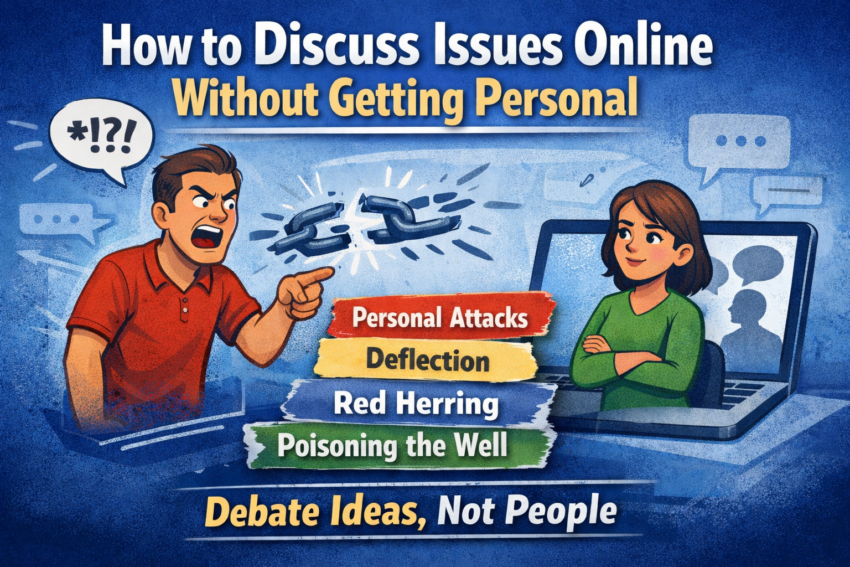
Online conversations have become one of the main ways residents share ideas, debate local issues, and stay informed. Whether the topic is city growth, water policy, schools, or neighborhood concerns, these discussions can be valuable — when they stay focused on the issue.
But many conversations follow a familiar pattern:
A discussion begins with facts or opinions, then suddenly shifts to name-calling, insults, or questioning someone’s motives. At that point, meaningful dialogue usually stops.
This article is a short guide to recognizing when a discussion has gone off track — and what to do when it does.
What Happens When Discussions Turn Personal
When someone responds to an argument by attacking the person making it rather than addressing the point itself, it’s known as a personal attack or ad hominem argument.
Common Ways Discussions Get Derailed
| Term | What It Means | What It Looks Like in Practice |
|---|---|---|
| Personal attack (Ad hominem) | Attacking the person instead of addressing their argument | “You’re ignorant,” “You’re corrupt,” “You don’t know anything” |
| Deflection | Shifting focus away from the original issue to avoid engaging with it | “Why aren’t you talking about this instead?” “You’re trying to control the narrative.” |
| Poisoning the well | Undermining someone’s character so their points are dismissed before being considered | “Nothing they say can be trusted” “Anything you say is spin.” |
| Red herring | Introducing an unrelated issue to derail the discussion | “What about this totally different problem?” |
| Argument by insult | Replacing reasoning with ridicule or mockery | Sarcasm, name-calling, or belittling language instead of evidence |
Instead of responding with:
“I disagree with your position because…”
The reply becomes:
“You’re ignorant,”
“You don’t know what you’re talking about,”
“You’re trying to control the narrative,” or
“People like you are the problem.”Once that shift happens, the conversation is no longer about the issue — it’s about winning, embarrassing, or shutting someone down.
Why Personal Attacks Shut Down Real Discussion
Personal attacks tend to:
- Distract from the actual topic
- Escalate emotions instead of resolving differences
- Discourage thoughtful people from participating
- Create an “us vs. them” dynamic rather than shared problem-solving
Most importantly, they don’t answer the original question. If a claim is wrong, it can be challenged with evidence. If an opinion is unpopular, it can be debated. Insults don’t do either.
How to Keep Discussions Focused on the Issue
If you’re participating in an online discussion, a few simple habits can keep things productive:
1. Address ideas, not people
Respond to what was said, not who said it. “I see it differently because…” works better than “You always…”
2. Ask clarifying questions
Sometimes tension comes from misunderstanding. “Can you clarify what you mean by…?”
3. Separate facts from opinions
It’s okay to disagree — just be clear about whether you’re debating data or values.
4. Know when to step back
Not every comment requires a reply. Silence can be more effective than escalation.
What to Do If a Discussion Turns Personal
If someone resorts to name-calling or insults, you have options — and none of them require returning fire.
Option 1: Calmly redirect
“Let’s stick to the issue. What part of my point do you disagree with?”
Option 2: Name the behavior without escalating
“That’s a personal attack, not a response to the argument.”
Option 3: Restate your point clearly
Sometimes clarity defuses tension: “My concern is about policy impact, not personalities.”
Option 4: Disengage
If the conversation no longer feels productive, it’s okay to step away. Walking away isn’t losing — it’s choosing not to participate in something unproductive.
Why This Matters for Our Community
Healthy communities depend on disagreement handled well. Local issues are complex, and reasonable people can reach different conclusions. Respectful debate helps everyone understand those differences — and occasionally, find common ground.
When discussions stay focused on ideas rather than insults, more voices feel welcome, and better solutions have a chance to emerge.

Mike Kieffer – Editor-in-Chief, Cedar Valley Sentinel
Mike Kieffer is a dynamic leader and community advocate based in Eagle Mountain, Utah. He serves as the Editor-in-Chief of the Cedar Valley Sentinel, a local publication dedicated to informing, inspiring, and elevating the Cedar Valley community through honest and accurate journalism. With a passion for fostering connections, Kieffer has made it his mission to highlight local businesses, provide reliable news, and support community development.
Beyond his editorial role, Kieffer is the owner of Lake Mountain Media, LLC, a company specializing in media and communications, and the co-owner of Quail Run Farms, which focuses on sustainable farming and community engagement. He also actively contributes to the local economy and culture as a member of the Eagle Mountain Chamber of Commerce.
Kieffer’s dedication extends to preserving and promoting the history and heritage of the Cedar Valley area. He often participates in community-centered events and media, including podcasts that explore the unique aspects of life in the region. Through his varied endeavors, he remains a steadfast advocate for the growth and enrichment of the local community.