
On February 5, 2026, Eagle Mountain City filed a lawsuit in Provo District Court against Cedar Valley Water Company, LLC (CVWC) to secure ownership of vital water assets. While the litigation involves historical deeds for over 3,100 acre-feet of water, legal counsel clarifies that the current dispute centers on a “spread” of approximately 885 acre-feet, with a possible value of ~$12 million.
The Foundations of Eagle Mountain: Land, Water, and Vision
Water and water rights have always been an issue in the Cedar Valley playing a very important role in the development of the city. In 1979 the Fitzgerald Family went to the Utah County Commission and had them approve the rezoning of 8,000 acres from grazing and mining zoning to residential zoning. Their goal was to “replace the typical asphalt jungle with a wholesome natural atmosphere where parents and children would be content to live.”1 The Fitzgeralds ran into financial struggles and a death in the family that resulted in the foreclosure of the land.
John Walden and other investors purchased the 8,000 acres with the water rights attached for $2.5 million at a bankruptcy auction.2 His goal was not to develop the area, but to move the water rights to another area in Utah for development. After purchasing the property, he learned these water rights could not be transferred to other areas. “Determined to turn his misfortune into fortune, Walden later picked up where the Fitzgerald’s left off and envisioned the creation of a new and innovative city.”3
A water right may be for a different parcel than the water is being used for, but they do have to both be in the same water right area. The state uses what are called Points of Diversion. This allows cities to use rights from one area to another in the shared aquifer. A water right in the south end of the city could be used to pull water from a well in the north end of the city. Making any water deed change a potential city-wide issue.4
In December 1996, the town of Eagle Mountain was officially incorporated. Strategic maps and drainage plans were established not just for John Walden’s original 8,000-acre purchase (12.5 square miles), but to encompass the broader expansion of the entire valley. At the time of its birth, historical accounts describe the town as covering more than 42 square miles, an area over three times larger than Walden’s initial holdings, laying the groundwork for what would become one of Utah’s geographically largest cities.5
Water deeded to city
On October 15, 1997, to meet the new city water requirements, Cedar Valley Water Company (CVWC) (a company managed by Walden) and US Bank enter into an escrow agreement. CVWC executes a deed to transfer 2,800 acre-feet, as stated in the complaint, of water to the bank. This deed contained a typo that specified the grantor Cedar Valley Company instead of Cedar Valley Water Company on it. The typo was noticed, the grantor was fixed to Cedar Valley Water Company, LLC, and the Corrected Water Rights deed was recorded.
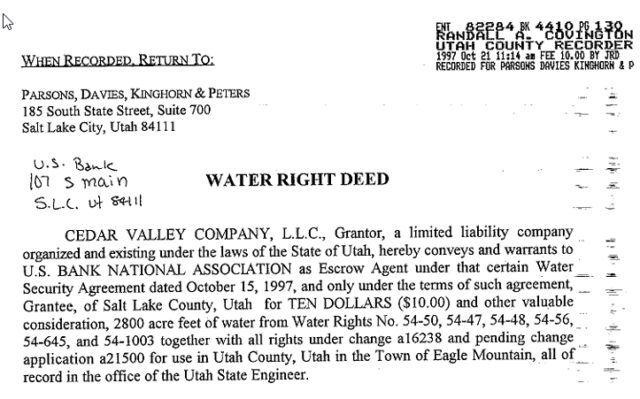
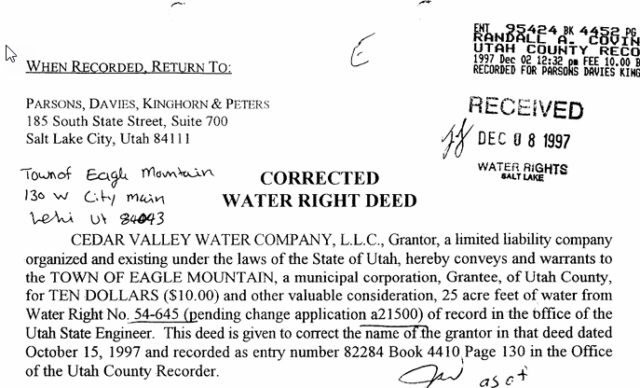
It is a significant historical detail that in February 1997, these water rights were transferred from Monte Vista Ranch, L.C. to Cedar Valley Water Company, L.C. via quitclaim deed. This effectively moved the assets between two entities under the common control of Walden. Today, Monte Vista Ranch, L.C., the same entity that initiated these early transfers, is embroiled in multiple high-profile legal disputes with Eagle Mountain City. Including a strategic attempt to take back the city’s rodeo grounds and a separate battle with two homeowners associations (Pioneer Addition and Autumn Ridge) over the validity of founding HOA documents.
Following the death of John Walden in 2017, the management of his various business interests was transferred to his daughter, who assumed control of the primary entities that founded and shaped the city. This succession included the oversight of Cedar Valley Water Company, LLC, Eagle Mountain Properties, L.C., and Monte Vista Ranch, L.C.
Administrative Title Dispute and the 1997 Clerical Error
For over two decades, Eagle Mountain City has operated under the understanding that these water rights were successfully transferred by US Bank and CVWC. The City has relied on these rights as the legal foundation to approve new subdivisions and provide water to thousands of residents.
In June 2021, the Utah Division of Water Rights (DWRi) issued a letter noting confusion in the public record due to a complex deed history. Because this notice was mailed to an outdated address, Eagle Mountain City remained unaware of the inquiry and did not provide a timely rebuttal.
During this period, Cedar Valley Water Company (CVWC) filed a formal response with the DWRi, asserting that certain historical transfers to the City were technically invalid due to naming errors in the 1997 deeds.
| Water Right No | Entry Number | Volume (af) | Value ($) |
|---|---|---|---|
| 54-48 | 21580 | 10.8 | $146,664.00 |
| 54-50 | 38623 | 47.0 | $638,260.00 |
| 54-50 | 44361 | 56.4 | $765,912.00 |
| 54-50 | 74496 | 38.78 | $526,632.40 |
| 54-50 | 74581 | 281.0 | $3,815,980.00 |
| 54-50 | 78763 | 355.32 | $4,825,245.60 |
| 54-50 | 21581 | 1.6 | $21,728.00 |
| 54-50 | 41007 | 0.45 | $6,111.00 |
| 54-645 | 82285 | 25.0 | $339,500.00 |
| 54-1003 | 114351 | 64.96 | $882,156.80 |
| Total | 881.31 af | $11,968,189.80 |
af (Acre-Foot): A unit of volume equal to the amount of water required to cover one acre of land to a depth of one foot (approx. 325,851 gallons).
Valuation Rate: $13,580 per 1 af. (per current consolidated fee schedule)6
Based on this unopposed information, the DWRi updated its internal administrative records to list CVWC as the owner of the disputed 885 acre-feet.
The City is now litigating to resolve this discrepancy. Legal counsel notes that while the DWRi updated its database, the County Recorder remains the official office of record for property ownership, and the City maintains that the original deeds should be recognized as valid municipal assets.
Understanding the General Adjudication
The Cedar Valley (Area 54) is currently undergoing a General Adjudication, a court-ordered “audit” to reconcile “paper water” (claims on record) with “wet water” (actual water available). Because the aquifer is over-appropriated, the State Engineer uses this process to ensure all claims are valid and backed by current records.
The Role of Municipal Protection
In Utah, water rights held by a “Public Water Supplier,” such as a city, benefit from a 40-year planning horizon, allowing them to hold water for future growth without the immediate risk of losing it due to non-use. Private entities, however, are generally subject to a 7-year “use it or lose it” rule.
The City’s lawsuit aims to restore its name to the administrative records to ensure these 885 acre-feet remain protected under the municipal “shield”. While no party has alleged that the water has been forfeited, the City argues that administrative clarity is essential to protect the community’s long-term water security.
Bottom Line
The ownership dispute involves approximately 885 acre-feet of water—enough to support roughly 1,770 households—with a current replacement value of approximately $12 million. The City is moving to “quiet title” to ensure this asset remains a permanent, protected part of the municipal infrastructure and to remove any legal clouds hanging over the affected neighborhoods. A quiet title does not mean they are trying to do it quietly, but it quiets all pending legal claims. In other words, it quiets the noise, and makes its title the title of record.
Current Lawsuit (Case# 260400524)
On February 5, 2026, Eagle Mountain City initiated formal legal proceedings against Cedar Valley Water Company, LLC (including its various associated aliases) to resolve a dispute over local water ownership. The case was filed in the Fourth Judicial District at the Provo District Court in Utah County and has been classified as a Property Rights matter.
Currently, the litigation is overseen by Judge Derek P. Pullan, who will preside over the City’s efforts to quiet title—a legal action to establish a party’s title to real property against any and all claimants. While the historical deeds referenced in the complaint involve a total of 3,119.39 acre-feet (covering Water Right Nos. 54-47, 54-48, 54-50, 54-56, 54-645, and 54-1003), legal counsel for the parties indicates that the actual discrepancy currently being litigated involves approximately 885 acre-feet.
The City’s goal in the proceedings is to correct the historical record and ensure these assets remain recognized as municipal property essential to the community’s infrastructure.
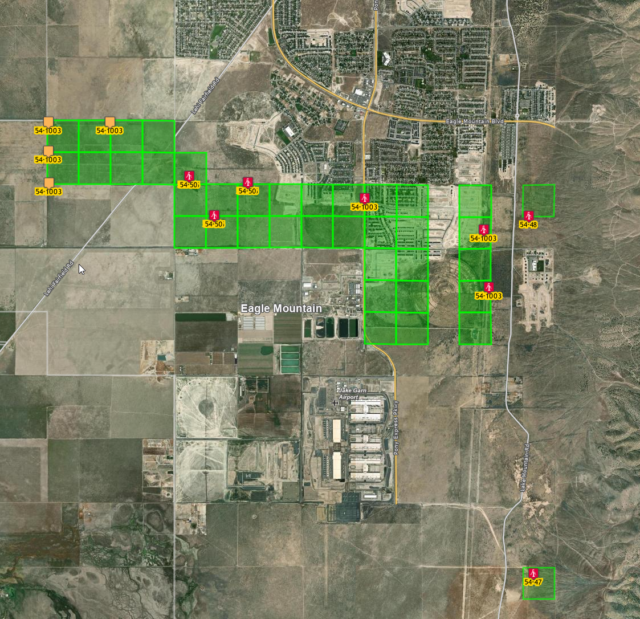
Eagle Mountain City argues that CVWC is acting unjustly by reclaiming water after reaping the financial benefits of getting its neighborhoods built. The City is asking the court to:
- Quieting Title of 2343.51 af of the water right
- Water Right No 54-47: 10.85
- Water Right No 54-48: 10.836
- Water Right No 54-50: 906.89
- Water Right No 54-645: 314.794
- Water Right No 54-1003: 1,100.14
- Make a judgement to acknowledge the typo and its fix
- CVWC deed an additional 93.646 af ($1,271,712.68) to Eagle Mountain City.
Water Right No 54-645 contains 315.24 af, but CVWC conveyed 408.886 af, leaving a balance of 93.646 owed from CVWC to Eagle Mountain City7 - Recover attorneys’ fees from CVWC
It should be noted that the Division of Water Rights is not the office of record; the County Recorder is. The Division does not have the authority to transfer ownership. It updates its records based on the information it has but the specific deeds control ownership.
Supporting Documents
Complaint filed by Eagle Mountain City vs Cedar Valley Water Company, LLC, (and aliases)
Original 1997 deed with typo
October 1997 water right agreement between Cedar Valley Water Company, US Bank, and Town of Eagle Mountain City
Footnotes
- Marci Purnell, A Ride from the Past on a Road to the Future: A History of Eagle Mountain, ed. Leah Woodard, with contributions by Debbie Hooge, Paul Bond, Robert Bateman, and Kelvin Bailey (Eagle Mountain, UT: Eagle Mountain City, 2005), 8. ↩︎
- John Walden, Eagle Mountain Founder’s Legacy Lives On, The Pinnacle List (2021), https://www.thepinnaclelist.com/articles/john-walden-eagle-mountain-founders-legacy-lives-on/ ↩︎
- Purnell, A Ride from the Past on a Road to the Future, 9. ↩︎
- Eagle Mountain City v. Cedar Valley Water Company, LLC, No. 260400524 (4th Dist. Ct. Utah Feb. 5, 2026). The water rights in question (Nos. 54-47, 54-48, 54-50, 54-56, 54-645, and 54-1003) were transferred alongside specific Change Applications (a16238 and a21500) designed to allow the City to move the water’s point of diversion to municipal wells. The City alleges it has “relied on these water right conveyances to meet the water demands of the specified developments” throughout its boundaries, making the ownership of these rights a fundamental requirement for the City’s continued operation of its integrated water system. ↩︎
- Purnell, A Ride from the Past on a Road to the Future, 13. ↩︎
- Eagle Mountain City, Consolidated Fee Schedule, § Water (Central Water Project Capital Amount), at 8. (eff. Jan. 7, 2026), available at https://eaglemountain.gov/wp-content/uploads/2026/01/Consolidated-Fee-Schedule-Current-1.7.26.pdf ↩︎
- Eagle Mountain City v. Cedar Valley Water Company, LLC, No. 260400524 (4th Dist. Ct. Utah Feb. 5, 2026) ↩︎
Photo by Gabriel Hyde on Unsplash

Mike Kieffer – Editor-in-Chief, Cedar Valley Sentinel
Mike Kieffer is a dynamic leader and community advocate based in Eagle Mountain, Utah. He serves as the Editor-in-Chief of the Cedar Valley Sentinel, a local publication dedicated to informing, inspiring, and elevating the Cedar Valley community through honest and accurate journalism. With a passion for fostering connections, Kieffer has made it his mission to highlight local businesses, provide reliable news, and support community development.
Beyond his editorial role, Kieffer is the owner of Lake Mountain Media, LLC, a company specializing in media and communications, and the co-owner of Quail Run Farms, which focuses on sustainable farming and community engagement. He also actively contributes to the local economy and culture as a member of the Eagle Mountain Chamber of Commerce.
Kieffer’s dedication extends to preserving and promoting the history and heritage of the Cedar Valley area. He often participates in community-centered events and media, including podcasts that explore the unique aspects of life in the region. Through his varied endeavors, he remains a steadfast advocate for the growth and enrichment of the local community.